Archives
-
LeXonomica
Vol. 18 No. 1 (2026)This publication is financially supported by ARIS - Slovenian Research and Innovation Agency
Izdajo publikacije finančno podpira ARIS - Javna agencija za znanstvenoraziskovalno in inovacijsko dejavnost Republike Slovenije
Editorial
Before you is the Vol. 18, No. 1 (2026) issue of LeXonomica journal, containing five scientific articles addressing current legal and economic issues.
The first article (“Procedural Balance or Structural Disadvantage? Legal Remedies and Defence Rights in European Investigation Order”) written by Teodora Kordiš, analyses certain legal dilemmas in connection to the European Investigation Order. Despite its advanced and structured regulation, the position of the defence in the EIO procedures remains uncertain in some countries. Directive 2014/41/EU does not provide a sufficient legal basis for the defence to issue an EIO independently, nor does it establish an explicit right to appeal against its issuance or execution. Although fundamental rights under the EU Charter and the ECHR apply to EIO proceedings, these standards are broadly framed and allow national discretion. The CJEU has taken a step forward, notably in Gavanozov II, highlighting the importance of legal remedies in EIO proceedings. Nonetheless, national criminal procedures still differ in key aspects, and significant gaps remain at the EU level in ensuring effective defence rights.
The second article (“Passing of Risk under CISG and Incoterms 2020 Rules: Legal framework and Contractual Autonomy”) written by Nastja Gorenc, analyses the relationship between CISG and Incoterms as key instruments regulating international sales contracts. Both frameworks reflect party autonomy, enabling parties to adapt contractual terms to the needs of modern global trade. CISG applies by default to international sales contracts under Art. 1 CISG, unless expressly excluded, while Incoterms apply through contractual incorporation or established usage. The article examines that Incoterms do not replace CISG but function alongside it, particularly regarding delivery and transfer of risk. Because Incoterms connect risk transfer to logistical events and CISG relies on legal criteria, inconsistencies may cause disputes when contracts are poorly drafted. In such cases, courts and tribunals interpret the parties’ agreement through Arts. 8, 9 CISG rather than redefining obligations. The article emphasizes that, despite some ambiguities in CISG’s risk provisions, it remains a major achievement in harmonizing international sales law. When combined with Incoterms, it provides a more effective framework for allocating risk and responsibilities. The article concludes that disputes are best avoided through clear drafting that regulates CISG’s role, the relevant Incoterms rule, and defines the parties’ obligations.
The third article (“Athletes' Data Protection Under the Slovenian, EU and International Regulations”) written by Suzana Kraljić and Ema Turnšek, outlines the athletes' data protection framework in Slovenia and addresses selected internationally recognised issues within this context. When it comes to athletes' data, we distinguish the competition data and performance data. The latter is particularly vulnerable and, at the same time, desired by various clubs or event organisers who want to monetise this data solely for their own benefit. In some cases, misuse or unlawful disclosures occur due to a lack of legal bases. However, in some other examples, the legal basis is provided by law – that is, especially common in cases of more comprehensive data collections gathered by official bodies or authorities, such as the Ministry of Sport. Furthermore, the article presents several legal acts that either directly or indirectly protect athletes' data. Even though the protection does not always specifically address athletes, but rather individuals in general, that does not mean the protection is inadequate or insufficient. Finally, the paper also addresses more specific topics – athletes' data protection in the event of anti-doping rule violations, as well as the particular regulation of athletes' health data.
The fourth article (“Copyright in the Republic of Croatia in Light of the New Copyright and Related Rights Act”) written by Blanka Mateša and Bruno Putnik, analyses the key changes introduced by the Croatian Copyright and Related Rights Act of 2021, particularly in the context of harmonisation with European Union law. Special attention is devoted to the historical development of copyright, the legal framework, and the digital environment, including the liability of online platforms, new rules governing the use of content, and the expansion of the rights of right holders. The paper also examines criticisms of the new Act, as well as the challenges and issues that have emerged in practice following its adoption. A range of scientific methods is employed, including inductive and deductive reasoning, methods of analysis and synthesis, abstraction and concretisation, generalisation and specialisation, classification, description, historical analysis, compilation, and comparative analysis. The paper concludes by confirming the initial hypothesis. It finds that the new Act represents an important step in the modernisation of the Croatian copyright system; however, its full effectiveness will depend on how its provisions are applied and interpreted in legal practice.
The fifth article (“Codification of Inspection: A Comparative Analysis of Croatia, Slovenia and Serbia”) written by Paula Šamanić Matijević and Klara Babić, analyses the contribution of codifying inspection rules to the more effective implementation of this procedure. Particular attention is given to the normative framework governing inspection in Croatia, which is currently regulated by numerous laws. Using a comparative legal method, the paper examines the legal frameworks in Slovenia and Serbia as examples of neighbouring countries where the rules on inspection have been codified. Based on the analysis conducted, the advantages of codifying inspection rules are assessed, and consideration is given to how the introduction of such codification could improve the quality of the legal regulation of inspection in the Republic of Croatia.
-
LeXonomica
Vol. 17 No. 2 (2025)This publication is financially supported by ARIS - Slovenian Research and Innovation Agency
Izdajo publikacije finančno podpira ARIS - Javna agencija za znanstvenoraziskovalno in inovacijsko dejavnost Republike Slovenije
Editorial
Before you is the Vol. 17, No. 2 (2025) issue of LeXonomica journal, containing four scientific articles addressing current legal and economic issues.
The first article (“Time-varying Granger Causality Between Health Care and Economic Activity in the United States”) written by Silvo Dajčman & Dejan Romih, analyses the time-varying relationship between health care and economic activity in the United States, filling a gap in the literature. Using time-varying Granger causality, the study provides empirical evidence of a time-varying causal relationship between health care spending and industrial production, which has important policy implications. The COVID-19 epidemic has led to the need to analyse the relationship between health care and the economy.
The second article (“Enforcement and Enforceability of Court Settlements in the European Union”) written by Martina Smojver, analyses the challenges which persist due to varying regulation and understanding of court settlements at the national level, as well as due to the ambiguities in the EU’s cross-border enforcement rules, leading to potential misinterpretations in practice. Thus, the paper aims to explore what exactly constitutes a ‘court settlement’, both at the national and at the EU level. Based on this definition, it then examines the EU regulatory framework, specifically within the selected EU regulations, to assess whether further improvements are necessary.
The third article (“Navigating Through Habitual Residence Determination”) written by Ines Medić & Josipa Begić, examines the private international law concept of habitual residence. Within the private international law area today, habitual residence seems to be omnipresent. Almost irrespective of the context, there seems to be no more appealing connecting factor than a habitual residence. The article provides an overview of the development of the concept, both in theory and in case law, with the aim of consolidating existing knowledge and seeking answers to the remaining questions.
The fourth article (“The Constitutionality of the Non-Recognition of Domestic Partnerships in South Africa: Revisited”) written by Razaana Denson, analyses the legal issue of Domestic Partnerships recognition in South Africa. Currently, there is an increasing number of couples who choose to live together without formalizing their relationship in the eyes of the law. These relationships where couples live together and set up a common household are referred to as domestic partnerships. South African family law only affords legal protection and recognition to civil marriages solemnised in terms of statutory law. The protection afforded to civil marriages does not extend to domestic partnerships. The question which arises is whether the law’s refusal to grant legal recognition and protection to domestic partnerships can be regarded as unconstitutional.
You are kindly invited to read on!
-
LeXonomica
Vol. 17 No. 1 (2025)This publication is financially supported by ARIS - Slovenian Research and Innovation Agency
Izdajo publikacije finančno podpira ARIS - Javna agencija za znanstvenoraziskovalno in inovacijsko dejavnost Republike Slovenije
Editorial
Before you is the Vol. 17, No. 1 (2025) issue of LeXonomica journal, containing five scientific articles addressing current legal and economic issues.
The first article (“Online Gambling Regulatory Policy: An Analysis from the Perspective of the Rights and Duties of the Gambler in Portugal”) written by João Ricardo Catarino & Carlos Henriques Machado, analyses the effectiveness of protecting online players' rights considering Portuguese legislation, which originates from the common European rules established for all Member States of the European Union. The study aims to characterise the Portuguese regulatory policy for games of chance, especially in the online gaming modality, its regulatory principles, its characteristics, and purposes, and to describe how it articulates with European recommendations. Based on this characterisation, the study analyses the effectiveness of compliance with the fundamental aspects of this regulatory policy by entities operating online gambling from the perspective of protecting the rights and duties of players, as enshrined.
The second article (“The Imperative of Revising the Arbitration Exception in the Brussels I bis Regulation”) written by Martina Tičić, analyses the Brussels I bis Regulation, i.e., the main instrument governing jurisdiction and recognition and enforcement of judgments in civil and commercial matters. The latter explicitly states that arbitration does not fall under its scope. This ‘arbitration exception’ has led to difficulties in practice, many of which have found their way to the Court of Justice of the EU (CJEU). However, as the CJEU case law shows, it only led to new questions. This paper thus presents the intricacies of the ‘thorny’ interplay of arbitration and court litigation in the EU. In order to remedy the existing problems in practice, two potential solutions are suggested.
The third article (“Strategic Integration of Sustainability, Circular Economy, and Blockchain in Slovenian Urban Governance”) written by Gorazd Justinek, examines how municipal sustainable development strategies incorporate emerging technologies, particularly blockchain, and innovative sustainability concepts such as the circular economy. Achieving the goals of Agenda 2030, especially transitioning to a circular economy, requires doubling energy efficiency by 2030. While blockchain and the circular economy have often been studied separately, this research explores their intersection within the context of urban sustainability. The study applies qualitative content analysis to the official development strategies of all 12 urban municipalities. This analysis is complemented by semi-structured interviews with senior officials from the Ministry of the Environment, Climate and Energy, and the Vice Mayor of Ljubljana, providing institutional perspectives on strategic priorities and implementation logic. This is the first comprehensive analysis of how Slovenian urban municipalities address the interconnected themes of sustainability, circular economy, and blockchain technology. The findings contribute to academic discussions and offer practical recommendations to enhance innovation in urban sustainability planning.
The fourth article (“Post-Contractual Non-Compete Clause in Commercial Agency Contracts”) written by Sebastjan Kerčmar, deals with the legal regime governing post-contractual non-compete clauses in commercial agency contracts, analysing Slovenian legislation and its compliance with Directive 86/653/EEC. The Slovenian Obligations Code (OZ) requires the mandatory payment of compensation for compliance with a non-compete clause only in cases where the contract is terminated for reasons attributable to the principal. The author stresses that such a regime may lead to a restriction of contractual freedom without adequate compensation, which is not in line with the spirit of the Directive. Based on a review of the regimes in respect of non-compete clauses after the termination of a commercial agency contract in various European countries, including Croatia, the author finds that the regimes vary considerably between countries. The paper also focuses on the impact of non-compete clauses on indemnity, as the OZ requires such clauses to be taken into consideration in determining the amount. The author draws attention to the need for a fair balance of interests and for legislation to be revised to ensure that agents are protected against disproportionate restrictions without adequate compensation.
The fifth article (“Protection of Workers in Relation to the Use of Artificial Intelligence in the Workplace”) written by Asja Lešnik, examines the impact of artificial intelligence (AI) on all stages of the employment relationship and analyses whether the current legal framework adequately protects workers from the risks posed by the use of AI in the workplace. The focus is on Slovenian labour law, while also considering relevant international and EU legal sources such as the AI Act, the Directive on Improving Working Conditions in Platform Work, the GDPR, and the EU Charter of Fundamental Rights. The author addresses legal challenges including discrimination, data protection, privacy, occupational safety and health, and liability for damages. The article finds that while some protective mechanisms already exist, none of the analysed legal sources comprehensively regulate AI use in employment relationships. To ensure effective worker protection, the author argues for either the amendment of current laws or the adoption of dedicated legislation. Since AI will play an even more significant role in Labour Law in the future, it is crucial for the law to adapt in a timely manner to the new challenges posed by AI.
You are kindly invited to read on!
-
LeXonomica
Vol. 16 No. 1 (2024)This publication is financially supported by ARIS - Slovenian Research and Innovation Agency
Izdajo publikacije finančno podpira ARIS - Javna agencija za znanstvenoraziskovalno in inovacijsko dejavnost Republike Slovenije

-
LeXonomica
Vol. 15 No. 2 (2023)This publication is financially supported by ARIS - Slovenian Research and Innovation Agency
Izdajo publikacije finančno podpira ARIS - Javna agencija za znanstvenoraziskovalno in inovacijsko dejavnost Republike Slovenije

-
LeXonomica
Vol. 16 No. 2 (2024)This publication is financially supported by ARIS - Slovenian Research and Innovation Agency
Izdajo publikacije finančno podpira ARIS - Javna agencija za znanstvenoraziskovalno in inovacijsko dejavnost Republike Slovenije
-
LeXonomica
Vol. 15 No. 1 (2023)This publication is financially supported by ARIS - Slovenian Research and Innovation Agency
Izdajo publikacije finančno podpira ARIS - Javna agencija za znanstvenoraziskovalno in inovacijsko dejavnost Republike Slovenije

-
Vol. 14 No. 2 (2022)
Publishing frequency: 2 issues per year
Editor-in-Chief: Matjaž Tratnik
(University of Maribor, Slovenia)The journal LeXonomica is indexed in Web of Science - Emerging Source Citation Index.
This publication is financially supported by ARRS - Slovenian Research Agency
Izdajo publikacije finančno podpira ARRS - Javna agencija za raziskovalno dejavnost Republike Slovenije
-
Vol. 14 No. 1 (2022)
Publishing frequency: 2 issues per year
Editor-in-Chief: Matjaž Tratnik
(University of Maribor, Slovenia)The journal LeXonomica is indexed in Web of Science - Emerging Source Citation Index.
This publication is financially supported by ARRS - Slovenian Research Agency
Izdajo publikacije finančno podpira ARRS - Javna agencija za raziskovalno dejavnost Republike Slovenije
-
Vol. 13 No. 2 (2021)
Publishing frequency: 2 issues per year
Editor-In-Chief: Matjaž Tratnik
The journal LeXonomica is indexed in Web of Science - Emerging Source Citation Index.
This publication is financially supported by ARRS - Slovenian Research Agency
Izdajo publikacije finančno podpira ARRS - Javna agencija za raziskovalno dejavnost Republike Slovenije
-
Vol. 13 No. 1 (2021)
Publishing frequency: 2 issues per year
Editor-In-Chief: Matjaž Tratnik
The journal LeXonomica is indexed in Web of Science - Emerging Source Citation Index.
This publication is financially supported by ARRS - Slovenian Research Agency
Izdajo publikacije finančno podpira ARRS - Javna agencija za raziskovalno dejavnost Republike Slovenije
-
Vol. 12 No. 2 (2020)
Publishing frequency: 2 issues per year
Editor-in-Chief: Martina Repas
The journal LeXonomica is indexed in Web of Science - Emerging Source Citation Index. -
Vol. 12 No. 1 (2020)
Publishing frequency: 2 issues per year
Editor-in-Chief: Martina Repas
The journal LeXonomica is indexed in Web of Science - Emerging Source Citation Index.
Licence: Free to read -
Vol. 11 No. 2 (2019)
Publishing frequency: 2 issues per year
Editor-in-Chief: Martina Repas
The journal LeXonomica is indexed in Web of Science - Emerging Source Citation Index.
Licence: Free to read -
Vol. 11 No. 1 (2019)
Publishing frequency: 2 issues per year
Editor-in-Chief: Martina Repas
The journal LeXonomica is indexed in Web of Science - Emerging Source Citation Index.
Licence: Free to read -
Vol. 10 No. 2 (2018)
Publishing frequency: 2 issues per year
Editor-in-Chief: Martina Repas
The journal LeXonomica is indexed in Web of Science - Emerging Source Citation Index.
Licence: Free to read -
Vol. 10 No. 1 (2018)
Publishing frequency: 2 issues per year
Editor-in-Chief: Martina Repas
The journal LeXonomica is indexed in Web of Science - Emerging Source Citation Index.
Licence: Free to read -

Vol. 9 No. 2 (2017)
Publishing frequency: 2 issues per year
Editor-in-Chief: Martina Repas
The journal LeXonomica is indexed in Web of Science - Emerging Source Citation Index.
Licence: Free to read -
Vol. 9 No. 1 (2017)
Publishing frequency: 2 issues per year
Editor-in-Chief: Martina Repas
The journal LeXonomica is indexed in Web of Science - Emerging Source Citation Index.
Licence: Free to read -
Vol. 8 No. 2 (2016)
Publishing frequency: 2 issues per year
Editor-in-Chief: Martina Repas
The journal LeXonomica is indexed in Web of Science - Emerging Source Citation Index.
Licence: Free to read -
Vol. 8 No. 1 (2016)
Publishing frequency: 2 issues per year
Editor-in-Chief: Martina Repas
The journal LeXonomica is indexed in Web of Science - Emerging Source Citation Index.
Licence: Free to read -
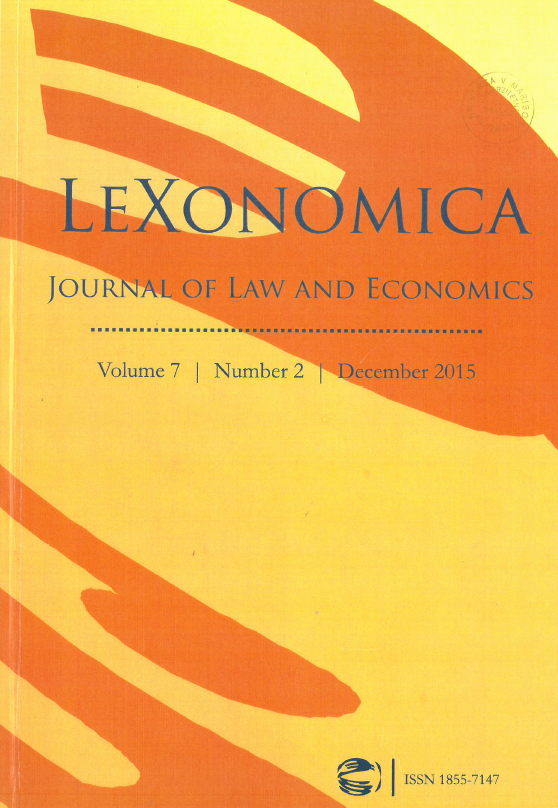
Vol. 7 No. 2 (2015)
Publishing frequency: 2 issues per year
Editor-in-Chief: Martina Repas
The journal LeXonomica is indexed in Web of Science - Emerging Source Citation Index.
Licence: Free to read -
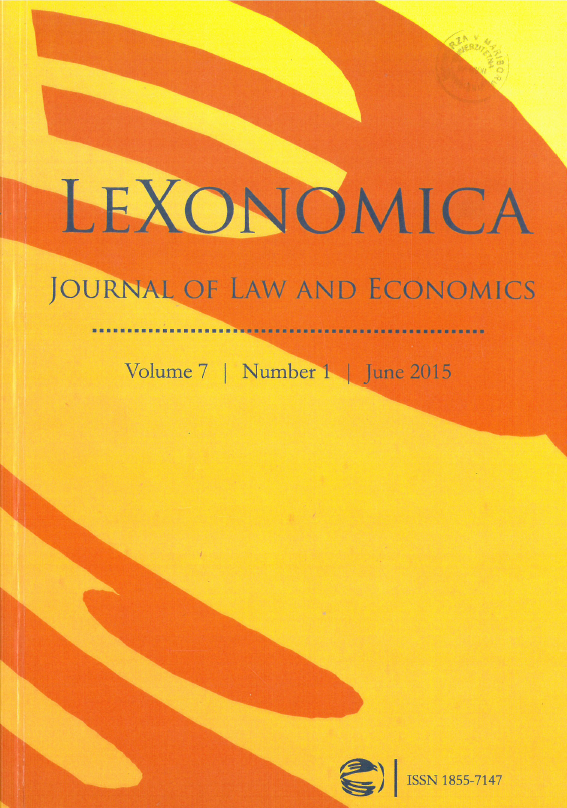
Vol. 7 No. 1 (2015)
Publishing frequency: 2 issues per year
Editor-in-Chief: Martina Repas
The journal LeXonomica is indexed in Web of Science - Emerging Source Citation Index.
Licence: Free to read -
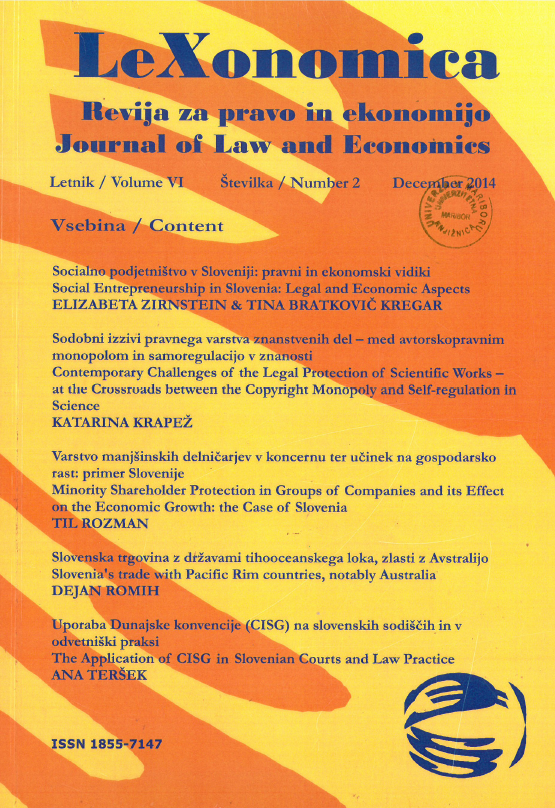
Vol. 6 No. 2 (2014)
Publishing frequency: 2 issues per year
Editor-in-Chief: Martina Repas
The journal LeXonomica is indexed in Web of Science - Emerging Source Citation Index.
Licence: Free to read -
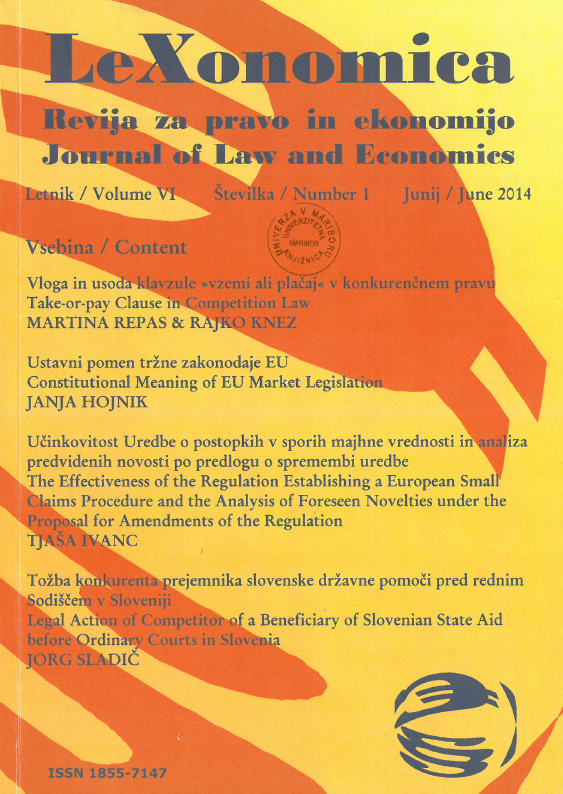
Vol. 6 No. 1 (2014)
Publishing frequency: 2 issues per year
Editor-in-Chief: Martina Repas
The journal LeXonomica is indexed in Web of Science - Emerging Source Citation Index.
Licence: Free to read
1-25 of 35
Next