Balancing the Benefits and Risks of SGLT2 Inhibitors
Koristi in pasti zdravljenja s SGLT-2 zaviralci
DOI:
https://doi.org/10.18690/actabiomed.300Keywords:
SGLT2 inhibitors, type 2 diabetes, chronic kidney disease, heart failure, clinical outcomesAbstract
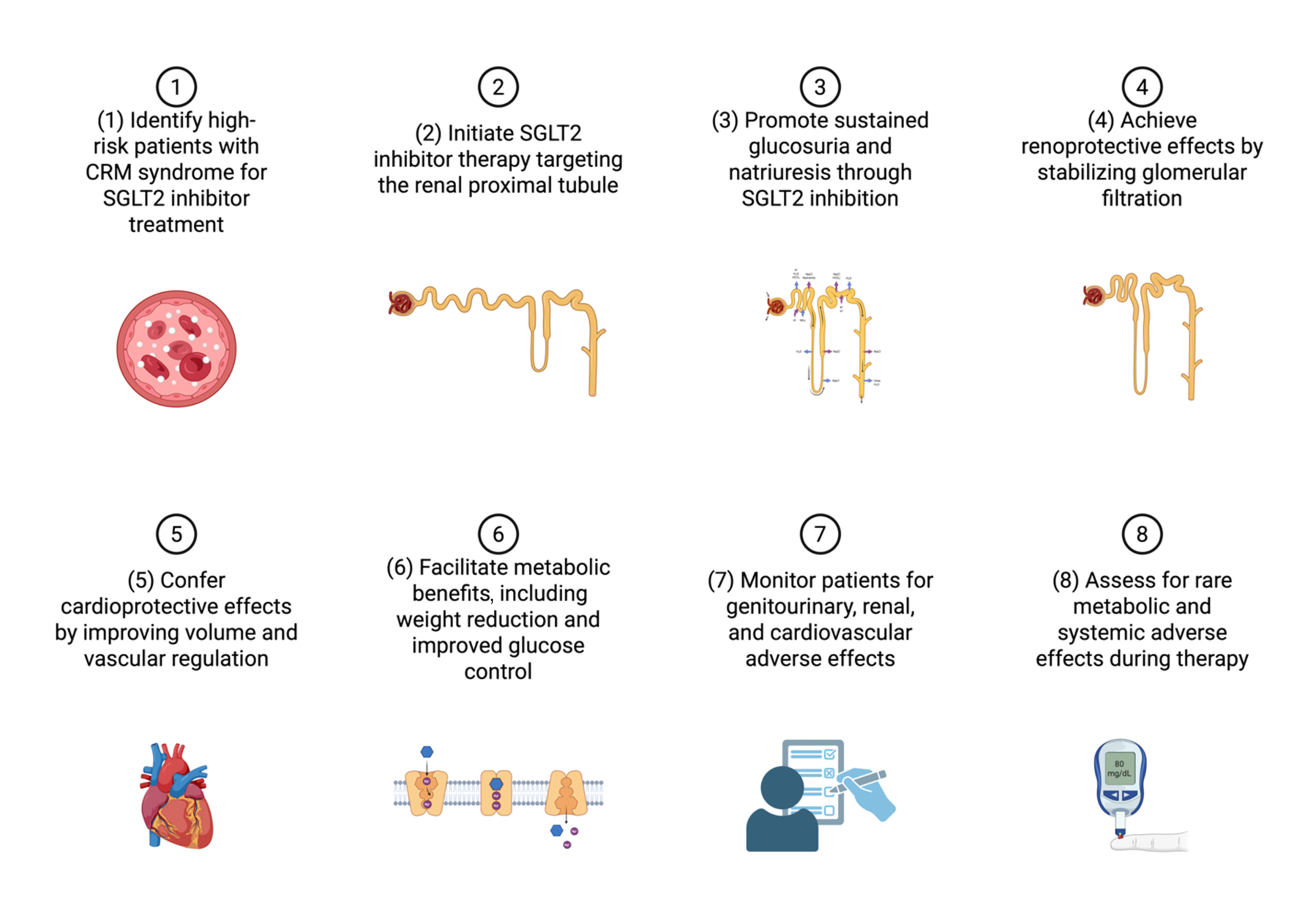
Cardiovascular, renal, and metabolic diseases frequently coexist and are leading contributors to global morbidity and mortality. Sodium–glucose cotransporter 2 inhibitors (SGLT2is), originally developed for the treatment of type 2 diabetes mellitus, have demonstrated substantial benefits extending beyond glycemic control. This review synthesizes current evidence on the renal, cardiovascular, and metabolic effects of SGLT2is and highlights key clinical outcome trials supporting use.
SGLT2is restore tubuloglomerular feedback, reduce intraglomerular pressure, and attenuate glomerular hyperfiltration by inhibiting sodium–glucose reabsorption in the proximal renal tubule, thereby slowing the progression of chronic kidney disease. Large randomized controlled trials have consistently demonstrated reductions in kidney disease progression, hospitalization for heart failure, and cardiovascular mortality in populations with and without diabetes. In addition, SGLT2is exert systemic effects, including modest reductions in body weight and blood pressure, improved metabolic efficiency, and modulation of inflammatory and oxidative stress pathways.
Adverse effects, including genitourinary infections, volume depletion, transient declines in renal function, and rare events, such as diabetic ketoacidosis and Fournier’s gangrene, are also discussed.
In summary, SGLT2is represent a transformative therapeutic strategy with broad, multi-system benefits across cardiovascular, renal, and metabolic diseases.
Downloads
References
1. Ndumele CE, Neeland IJ, Tuttle KR, Chow SL, Mathew RO, Khan SS, et al. A Synopsis of the Evidence for the Science and Clinical Management of Cardiovascular-Kidney-Metabolic (CKM) Syndrome: A Scientific Statement From the American Heart Association. Circulation. 2023;148(20):1636-64.
2. Ferdinand KC. An overview of cardiovascular-kidney-metabolic syndrome. Am J Manag Care. 2024;30(10 Suppl):S181-S8.
3. Mavrakanas TA, Tsoukas MA, Brophy JM, Sharma A, Gariani K. SGLT-2 inhibitors improve cardiovascular and renal outcomes in patients with CKD: a systematic review and meta-analysis. Sci Rep. 2023;13(1):15922.
4. Padda IS, Mahtani AU, Parmar M. Sodium-Glucose Transport 2 (SGLT2) Inhibitors. StatPearls. Treasure Island (FL): StatPearls Publishing
Copyright © 2026, StatPearls Publishing LLC.; 2026.
5. Lee Y-h, Lim S, Davies MJ. Cardiometabolic and renal benefits of sodium–glucose cotransporter 2 inhibitors. Nature Reviews Endocrinology. 2025;21(12):783-98.
6. Santulli G, Varzideh F, Forzano I, Wilson S, Salemme L, de Donato A, et al. Functional and Clinical Importance of SGLT2-inhibitors in Frailty: From the Kidney to the Heart. Hypertension. 2023;80(9):1800-9.
7. Layton AT, Vallon V. Did you know how SGLT2 inhibitors protect the kidney? Acta Physiol (Oxf). 2023;238(4):e14011.
8. Schork A, Eberbach ML, Bohnert BN, Worn M, Heister DJ, Eisinger F, et al. SGLT2 Inhibitors Decrease Overhydration and Proteasuria in Patients with Chronic Kidney Disease: A Longitudinal Observational Study. Kidney Blood Press Res. 2024;49(1):124-34.
9. Vallon V, Verma S. Effects of SGLT2 Inhibitors on Kidney and Cardiovascular Function. Annu Rev Physiol. 2021;83:503-28.
10. Wiviott SD, Raz I, Bonaca MP, Mosenzon O, Kato ET, Cahn A, et al. Dapagliflozin and Cardiovascular Outcomes in Type 2 Diabetes. N Engl J Med. 2019;380(4):347-57.
11. Zinman B, Wanner C, Lachin JM, Fitchett D, Bluhmki E, Hantel S, et al. Empagliflozin, Cardiovascular Outcomes, and Mortality in Type 2 Diabetes. N Engl J Med. 2015;373(22):2117-28.
12. The E-KCG, Herrington WG, Staplin N, Wanner C, Green JB, Hauske SJ, et al. Empagliflozin in Patients with Chronic Kidney Disease. N Engl J Med. 2023;388(2):117-27.
13. Perkovic V, Jardine MJ, Neal B, Bompoint S, Heerspink HJL, Charytan DM, et al. Canagliflozin and Renal Outcomes in Type 2 Diabetes and Nephropathy. N Engl J Med. 2019;380(24):2295-306.
14. Swedberg K, Ryden L. Treatment of diabetes and heart failure: joint forces. Eur Heart J. 2016;37(19):1535-7.
15. Chen JY, Pan HC, Shiao CC, Chuang MH, See CY, Yeh TH, et al. Impact of SGLT2 inhibitors on patient outcomes: a network meta-analysis. Cardiovasc Diabetol. 2023;22(1):290.
16. Varda L, Vreča N, Ekart R, Bevc S, Piko N. Diabetic Kidney Disease: From Pathophysiology to Treatment Perspectives. Kidney Blood Press Res. 2026;51(1):107-27.
17. Pittampalli S, Upadyayula S, Mekala HM, Lippmann S. Risks vs Benefits for SGLT2 Inhibitor Medications. Fed Pract. 2018;35(7):45-8.
18. Nelinson DS, Sosa JM, Chilton RJ. SGLT2 inhibitors: a narrative review of efficacy and safety. J Osteopath Med. 2021;121(2):229-39.
19. Ravindran S, Munusamy S. Renoprotective mechanisms of sodium-glucose co-transporter 2 (SGLT2) inhibitors against the progression of diabetic kidney disease. J Cell Physiol. 2022;237(2):1182-205.
20. Fonseca-Correa JI, Correa-Rotter R. Sodium-Glucose Cotransporter 2 Inhibitors Mechanisms of Action: A Review. Front Med (Lausanne). 2021;8:777861.
21. Packer M. Interplay of adenosine monophosphate-activated protein kinase/sirtuin-1 activation and sodium influx inhibition mediates the renal benefits of sodium-glucose co-transporter-2 inhibitors in type 2 diabetes: A novel conceptual framework. Diabetes Obes Metab. 2020;22(5):734-42.
22. Packer M. Role of Impaired Nutrient and Oxygen Deprivation Signaling and Deficient Autophagic Flux in Diabetic CKD Development: Implications for Understanding the Effects of Sodium-Glucose Cotransporter 2-Inhibitors. J Am Soc Nephrol. 2020;31(5):907-19.
23. Mascolo A, Di Napoli R, Balzano N, Cappetta D, Urbanek K, De Angelis A, et al. Safety profile of sodium glucose co-transporter 2 (SGLT2) inhibitors: A brief summary. Front Cardiovasc Med. 2022;9:1010693.
24. Upadhyay A. SGLT2 Inhibitors and Kidney Protection: Mechanisms Beyond Tubuloglomerular Feedback. Kidney360. 2024;5(5):771-82.
25. Li N, Zhou H. Sodium-glucose Cotransporter Type 2 Inhibitors: A New Insight into the Molecular Mechanisms of Diabetic Nephropathy. Curr Pharm Des. 2022;28(26):2131-9.
26. Alexander JT, Staab EM, Wan W, Franco M, Knitter A, Skandari MR, et al. Longer-term Benefits and Risks of Sodium-Glucose Cotransporter-2 Inhibitors in Type 2 Diabetes: a Systematic Review and Meta-analysis. J Gen Intern Med. 2022;37(2):439-48.
27. Huang B, Yen CL, Wu CY, Tsai CY, Chen JJ, Hsiao CC, et al. Author Correction: SGLT2 inhibitors reduce the risk of renal failure in CKD stage 5 patients with Type 2 DM. Sci Rep. 2025;15(1):12440.
28. Jeon JY, Kim DJ. Benefit and Safety of Sodium-Glucose Co-Transporter 2 Inhibitors in Older Patients with Type 2 Diabetes Mellitus. Diabetes Metab J. 2024;48(5):837-46.
29. Fried H, Harris YT, Schulman-Rosenbaum R. Pros and Cons of Inpatient SGLT2i Use for Hyperglycemia and Heart Failure. J Endocr Soc. 2025;9(2):bvae229.
30. Van Craenenbroeck AH, Chinnappa S, Dounousi E, Fernandez-Fernandez B, Iatridi F, Mark PB, et al. New kidneys, old risks: cardiovascular challenges after transplantation. Nephrology Dialysis Transplantation. 2025.
31. Chowdhury T, Gousy N, Bellamkonda A, Dutta J, Zaman CF, Zakia UB, et al. Fournier's Gangrene: A Coexistence or Consanguinity of SGLT-2 Inhibitor Therapy. Cureus. 2022;14(8):e27773.
32. Konta Y, Saito E, Sato K, Furuta K, Miyauchi K, Furukawa A, et al. Tubulointerstitial Nephritis after Using a Sodium-glucose Cotransporter 2 Inhibitor. Intern Med. 2022;61(21):3239-43.
33. Joyce E, Glasner P, Ranganathan S, Swiatecka-Urban A. Tubulointerstitial nephritis: diagnosis, treatment, and monitoring. Pediatr Nephrol. 2017;32(4):577-87.
34. Kleinjan JP, Blom J, van Beek AP, Bouma HR, van Dijk PR. Balancing Risks and Benefits: Sodium-Glucose Cotransporter 2 Inhibitors and the Risk of Diabetic Ketoacidosis. Metabolites. 2024;14(3).
35. Lyu B, Hwang YJ, Selvin E, Jameson BC, Chang AR, Grams ME, et al. Glucose-Lowering Agents and the Risk of Hypoglycemia: a Real-world Study. Journal of General Internal Medicine. 2023;38(1):107-14.
Downloads
Published
Data Availability Statement
This manuscript is based on previously available data.
Issue
Section
License
Copyright (c) 2026 Alex Forštnarič, Ana Stajan, Nejc Piko (Author)

This work is licensed under a Creative Commons Attribution 4.0 International License.