The Need for a Pacemaker after TAVI can be Influenced by Careful Planning and Predicted by Higher Troponin Values after Implantation Study
Z natančnim načrtovanjem implantacije lahko vplivamo na potrebo po srčnem spodbujevalniku po TAVI, to pa lahko predvidimo z vrednostjo troponina po posegu
DOI:
https://doi.org/10.18690/actabiomed.297Keywords:
transcatheter aortic valve implantation, pacemaker, conduction abnormalities, troponin, hospital stay, survivalAbstract
Aim: Conduction abnormalities that require the implantation of a permanent pacemaker (PM) are known to accompany transcatheter aortic valve implantation (TAVI). Specific patient-dependent and procedure-related features are known to correlate with higher pacemaker implantation rates.
Methods: We analysed retrospective data from a single centre with 150 TAVI cases in 2023. Fourteen cases had a PM already implanted and two were excluded due to a change to surgery and repeated TAVI in the same month.
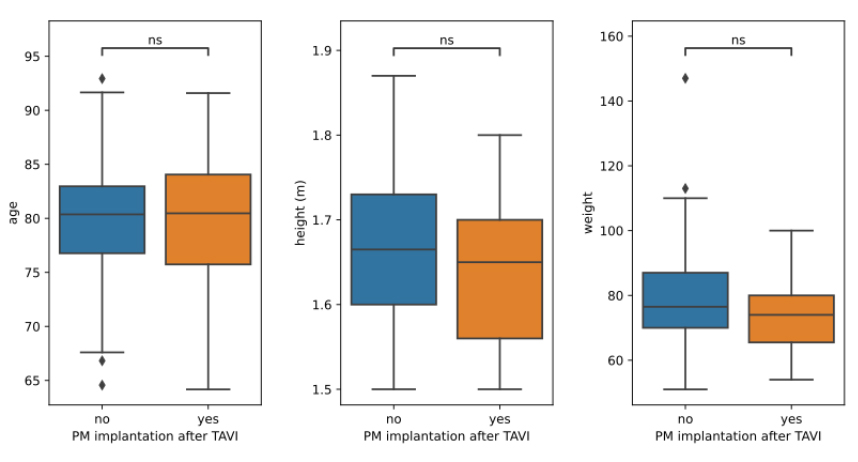
Results: Two types of transcatheter heart valves (THVs) were implanted and chosen based on computer tomography scans. Nineteen patients (14%) required PM after TAVI and all underwent implantation in the same hospital. There was no difference in the type of THV implanted. Patients that required PM had preexisting right bundle branch block more frequently (20% vs. 9%, p = 0.355), but this was not significantly different. They had however, have significantly higher values of troponin (p = 0.012) and required longer hospitalisations (p = 0.007). On first outpatient control, patients with PM implants had an average of 95% of ventricular pacing, no difference in ejection fraction, and no difference in three month survival compared to patients without a PM implanted.
Conclusions: The need for a PM after TAVI can be predicted and avoided to some point. Every TAVI procedure should be carefully planned. Well implanted PMs carry no risks for short term survival.
Downloads
References
1. Vahanian A, Beyersdorf F, Praz F, Milojevic M, Baldus S, Bauersachs J, et al. 2021 ESC/EACTS Guidelines for the management of valvular heart disease: Developed by the Task Force for the management of valvular heart disease of the European Society of Cardiology (ESC) and the European Association for Cardio-Thoracic Surgery (EACTS). Eur Heart J. 2022 Feb 14;43(7):561–632.
2. Jørgensen T, Hansson N, Backer OD, Bieliauskas G, Terkelsen CJ, Wang X, et al. EuroIntervention. [cited 2022 Dec 18]. Membranous septum morphology and risk of conduction abnormalities after transcatheter aortic valve implantation. Available from: https://eurointervention.pcronline.com/article/membranous-septum-morphology-predicting-the-risk-of-conduction-abnormalities-after-transcatheter-aortic-valve-implantation
3. Feng Z, Choy H hin, Shin S, Vu A, Schricker A, Hongo R, et al. Abstract 10530: Incidence and Electrocardiographic Predictors of Atrioventricular Conduction Recovery After Permanent Pacemaker Implantation in Transcatheter Aortic Valve Replacement. Circulation. 2022 Nov 8;146(Suppl_1):A10530–A10530.
4. Vashistha K, Tobaa A, Doyle M, Bartley S, Bailey S, Biederman RW. Abstract 9606: Prognostic Significance of Interventricular and Mitral Calcification on Permanent Pacemaker Implantation Post Tavr. Is All That Glitters Gold? Circulation. 2021 Nov 16;144(Suppl_1):A9606–A9606.
5. Breitbart P, Minners J, Hein M, Schröfel H, Neumann FJ, Ruile P. Implantation depth and its influence on complications after TAVI with self-expanding valves. Int J Cardiovasc Imaging. 2021;37(10):3081–92.
6. Mangieri A, Montalto C, Pagnesi M, Lanzillo G, Demir O, Testa L, et al. TAVI and Post Procedural Cardiac Conduction Abnormalities. Front Cardiovasc Med. 2018 Jul 3;5:85.
7. Regueiro A, Abdul-Jawad Altisent O, Del Trigo M, Campelo-Parada F, Puri R, Urena M, et al. Impact of New-Onset Left Bundle Branch Block and Periprocedural Permanent Pacemaker Implantation on Clinical Outcomes in Patients Undergoing Transcatheter Aortic Valve Replacement. Circ Cardiovasc Interv. 2016 May;9(5):e003635.
8. Glikson M, Nielsen JC, Kronborg MB, Michowitz Y, Auricchio A, Barbash IM, et al. 2021 ESC Guidelines on cardiac pacing and cardiac resynchronization therapy: Developed by the Task Force on cardiac pacing and cardiac resynchronization therapy of the European Society of Cardiology (ESC) With the special contribution of the European Heart Rhythm Association (EHRA). Eur Heart J. 2021 Sep 14;42(35):3427–520.
9. 10. Zito A, Princi G, Lombardi M, D’Amario D, Vergallo R, Aurigemma C, et al. Long-term clinical impact of permanent pacemaker implantation in patients undergoing transcatheter aortic valve implantation: a systematic review and meta-analysis. Eur Eur Pacing Arrhythm Card Electrophysiol J Work Groups Card Pacing Arrhythm Card Cell Electrophysiol Eur Soc Cardiol. 2022 Jul 21;24(7):1127–36.
10. Ravaux JM, Di Mauro M, Vernooy K, Van’t Hof AW, Veenstra L, Kats S, et al. One-year pacing dependency after pacemaker implantation in patients undergoing transcatheter aortic valve implantation: Systematic review and meta-analysis. JTCVS Open. 2021 Feb 12;6:41-55.e15.
11. Ullah W, Zahid S, Zaidi SR, Sarvepalli D, Haq S, Roomi S, et al. Predictors of Permanent Pacemaker Implantation in Patients Undergoing Transcatheter Aortic Valve Replacement ‐ A Systematic Review and Meta‐Analysis. J Am Heart Assoc. 2021 Jul 20;10(14):e020906.
12. Ancona MB, Moroni F, Pagnesi M, Del Sole P, Demir O, Khawaja S, et al. Impact of Left Ventricular Outflow Tract Calcification on Pacemaker Implantation After Transcatheter Aortic Valve Implantation With Second-Generation Devices. J Invasive Cardiol. 2020 May;32(5):180–5.
13. American College of Cardiology [Internet]. [cited 2025 Apr 1]. Risk Stratification for Pacemaker Placement After TAVR. Available from: https://www.acc.org/latest-in-cardiology/articles/2016/04/26/15/22/http%3a%2f%2fwww.acc.org%2flatest-in-cardiology%2farticles%2f2016%2f04%2f26%2f15%2f22%2frisk-stratification-for-pacemaker-placement-after-tavr
14. Sharma E, McCauley B, Ghosalkar DS, Atalay M, Collins S, Parulkar A, et al. Aortic Valve Calcification as a Predictor of Post-Transcatheter Aortic Valve Replacement Pacemaker Dependence. Cardiol Res. 2020 Jun;11(3):155–67.
15. Latsios G, Gerckens U, Buellesfeld L, Mueller R, John D, Yuecel S, et al. “Device landing zone” calcification, assessed by MSCT, as a predictive factor for pacemaker implantation after TAVI. Catheter Cardiovasc Interv. 2010;76(3):431–9.
16. Auffret V, Puri R, Urena M, Chamandi C, Rodriguez-Gabella T, Philippon F, et al. Conduction Disturbances After Transcatheter Aortic Valve Replacement. Circulation. 2017 Sep 12;136(11):1049–69.
17. Apiyasawat S, Chandavimol M, Soontornmanokati N, Sirikhamkorn C. Ventricular pacing dependency after transcatheter aortic valve replacement: a prospective cohort. Cardiovasc Diagn Ther. 2023 Aug 31;13(4):628–37.
18. Solberg OG, Ueland ,Thor, Wergeland ,Ragnhild, Dahl ,Christen P., Aakhus ,Svend, Aukrust ,Pål, et al. High-sensitive troponin T and N-terminal-brain-natriuretic-peptide predict outcome in symptomatic aortic stenosis. Scand Cardiovasc J. 2012 Oct 1;46(5):278–85.
19. Akodad M, Spaziano M, Chevalier B, Garot P, Benamer H, Dinan‐Zannier A, et al. Prognostic Impact of Pre‐Transcatheter and Post‐Transcatheter Aortic Valve Intervention Troponin: A Large Cohort Study. J Am Heart Assoc Cardiovasc Cerebrovasc Dis. 2019 Mar 14;8(6):e011111.
20. Koifman E, Garcia-Garcia HM, Alraies MC, Buchanan K, Hideo-Kajita A, Steinvil A, et al. Correlates and Significance of Elevation of Cardiac Biomarkers Elevation Following Transcatheter Aortic Valve Implantation. Am J Cardiol. 2017 Sep 1;120(5):850–6.
Downloads
Published
Issue
Section
License
Copyright (c) 2026 Nina Glavnik Poznič, Vojko Kanič (Author)

This work is licensed under a Creative Commons Attribution 4.0 International License.