Fournier’s gangrene in a female patient: a case report
Fournierjeva gangrena pri ženski: prikaz primera
DOI:
https://doi.org/10.18690/actabiomed.296Keywords:
Fournier’s gangrene, female, necrotising fasciitis, case report, multidisciplinary approachAbstract
Purpose: Fournier’s gangrene is a rare life-threatening form of necrotizing fasciitis that affects the genital, perineal and perianal regions. A significantly higher mortality rate occurs in females due to anatomic differences and greater susceptibility to peritonitis and retroperitonitis. Common risk factors for Fournier’s gangrene include diabetes melitus, substance abuse, liver failure, and immunosuppression.
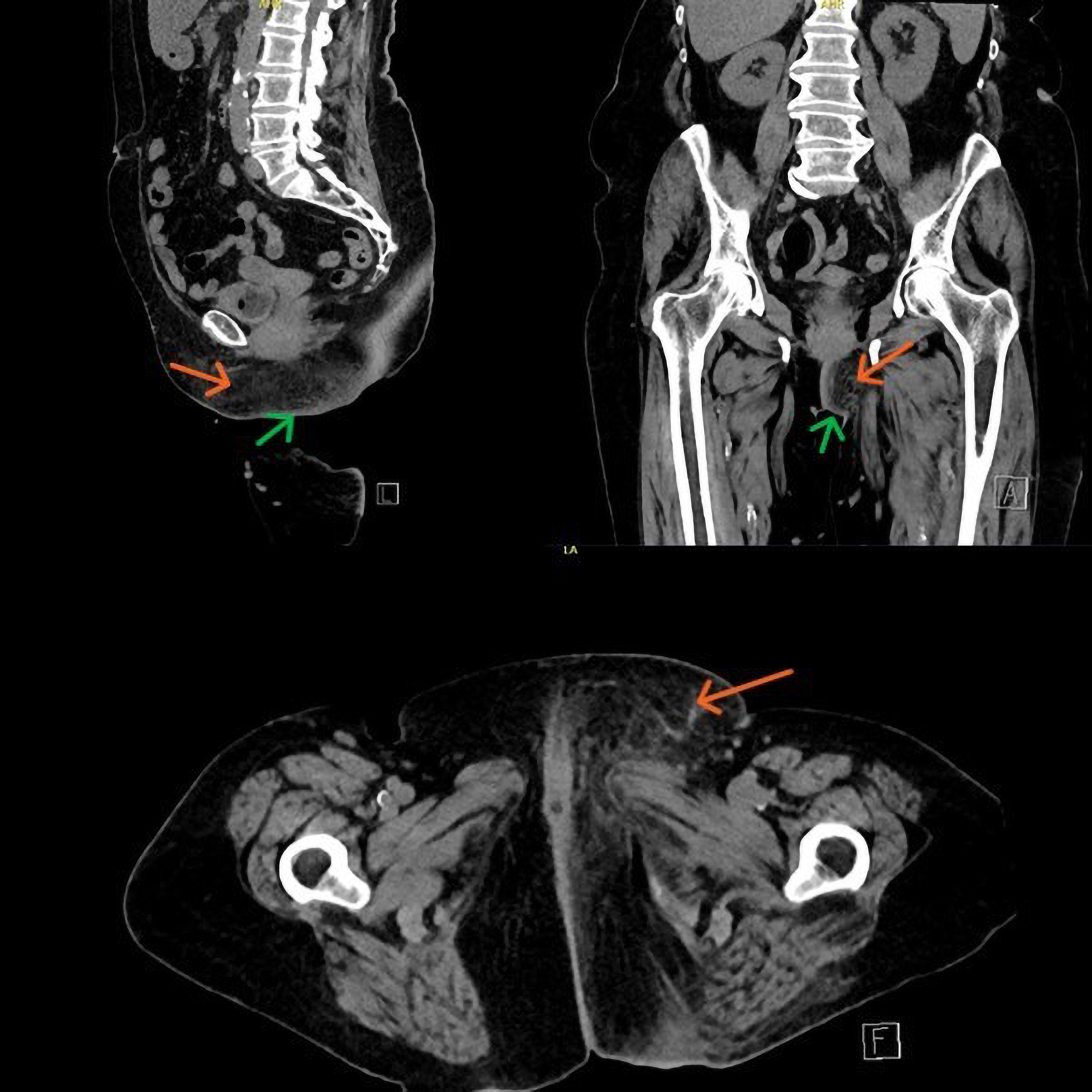
Case presentation: A 73-year-old woman collapsed and was transported to the emergency room tachycardic and in atrial fibrillation. Earlier that day she had an appointment with her gynecologist for evaluation of an inflamed, erythematous, painful left labia, which the gynecologist treated with antibiotics.
Downloads
References
1. Susini P., Marcaccini G., Efica J., Giuffrè MT., Mazzotta R, Caneschi C., et al. Fournier’s Gangrene Surgical Reconstruction: A Systematic Review. Journal of Clinical Medicine. 2024,13, 4085–5, doi: 10.3390/jcm13144085
2. Kundan M, Ambedkar SN, Kumar R, Nyekha V. Outcome of Fournier’s gangrene in relation to Fournier Gangrene Severity Index (FGSI) score. Journal of Family Medicine and Primary Care. 2024, 13, 2941–5, doi: 10.4103/jfmpc.jfmpc_1830_23.
3. Abbasi B, Hacker E, Ghaffar U, Hakam N, Li KD, Alazzawi S, et al. Higher Morbidity and Mortality in Women With Fournier Gangrene Compared With Men: Insights From National Inpatient Sample Data. J Urol. 2025, 213, 99-109, doi: 10.1097/JU.0000000000004264.
4. Desai R, Batura D. A contemporaneous narrative review of Fournier’s gangrene. Urologia. 2023, 90, 201-8. doi: 10.1177/03915603231165067
5. Yönder H, Çelik M, Berhuni MS, Genç AC, Elkan H, Tatlı F, et al. Fournier’s Gangrene Mortality Index (FGMI): A New Scoring System for Predicting Fournier’s Gangrene Mortality. Diagnostics. 2024, 14, 2732, doi: 10.3390/diagnostics14232732
6. Wróblewska, M., Kuzaka, B., Borkowski, T., Kuzaka, P., Kawecki, D., & Radziszewski, P. Fournier's gangrene--current concepts. Pol J Microbiol. 2014, 63, 267–73.
7. Lewis GD, Majeed M, Olang CA, Patel A, Gorantla VR, Davis N, et al. Fournier’s Gangrene Diagnosis and Treatment: A Systematic Review. Cureus. 2021, 13, doi: 10.7759/cureus.18948
8. Koch GE, Abbasi B, Agoubi L, Breyer BN, Clark N, Dick BP, et al. Multidisciplinary Management in Fournier’s Gangrene. Curr Probl Surg. 2024, 61, doi: 10.1016/j.cpsurg.2024.101499
9. Singh A, Ahmed K, Aydin A, Khan MS, Dasgupta P. Fournier's gangrene. A clinical review. Arch Ital Urol Androl. 2016, 88, 157-64, doi: 10.4081/aiua.2016.3.157.
10. El-Qushayri AE, Khalaf KM, Dahy A, Mahmoud AR, Benmelouka AY, Ghozy S, et. al. Fournier's gangrene mortality: A 17-year systematic review and meta-analysis. Int J Infect Dis. 2020, 92, 218-25, doi: 10.1016/j.ijid.2019.12.030.
Downloads
Published
Issue
Section
License
Copyright (c) 2026 Nadja Novak Skodič, Tomislav Magdalenič, Gregor Petrun, Timea Hebar, Iztok Takač (Author)

This work is licensed under a Creative Commons Attribution 4.0 International License.