Diagnostics and Treatment of Dementia in Radovljica Health Center - A Retrospective Study
Diagnostika in zdravljenje demence v Zdravstvenem domu Radovljica – retrospektivna študija
DOI:
https://doi.org/10.18690/actabiomed.298Keywords:
Dementia, Slovenia, Family Medicine, Cognitive Assessment, MMSE, CDT, MoCAAbstract
Aim: The aim of this study was to determine whether patients with newly diagnosed dementia underwent an assessment of cognitive status and which assessment tool was used. We also examined whether patients underwent laboratory and imaging diagnostics and investigated whether they were prescribed anti-dementia medication by their family physician or referred to a clinical specialist (neurologist or psychiatrist).
Methods: A retrospective quantitative study was conducted at the Radovljica Health Center, based on an analysis of patients’ medical records from January 1, 2014, to December 31, 2018.
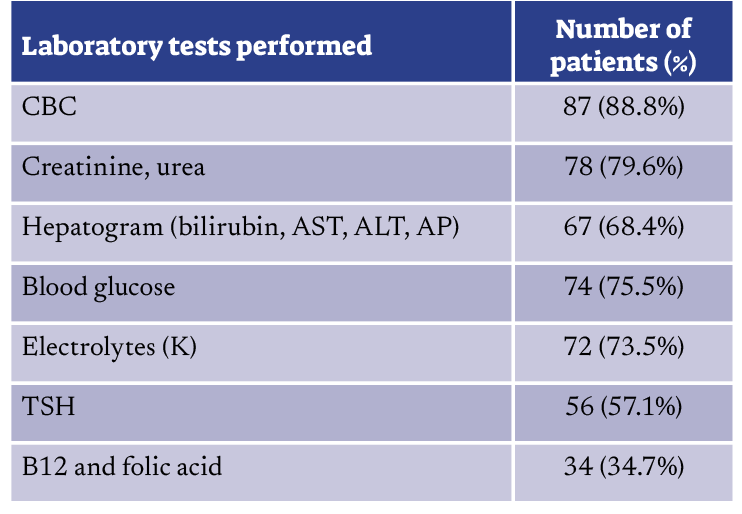
Results: The study included 98 patients, 28.6% males (n = 28) and 71.4% females (n = 70), aged 75 to 96 years. Patients had average of 3.7 chronic non-communicable diseases, most commonly arterial hypertension (81.6%, n = 80) and hyperlipidemia (41.8%, n = 41). Patients were prescribed an average of 4.2 regular medications. Cognitive status was assessed in 19.4% (n = 19) of patients; the Mini-Mental State Examination (MMSE) was used most frequently (89.5%, n = 17), followed by the Clock Drawing Test (CDT) and the Montreal Cognitive Assessment (MoCA) in 5.3% (n = 1) of cases each. In the year of diagnosis, laboratory tests were performed in 88.8% (n = 87) of patients, of whom basic laboratory tests were conducted in 65.3% (n = 64). A total of 25.5% (n = 25) of patients were referred for imaging diagnostics, while 79.6% (n = 78) of patients were referred to clinical specialists: 28.6% (n = 28) to psychiatrists and 51.0% (n = 50) to neurologists. Anti-dementia medication was initiated by family medicine physicians in 9.8% (n = 10) of cases at the time of diagnosis.
Conclusions: This study found that there is room for improvement in the diagnosis and treatment of dementia at the primary care level (cognitive assessment, laboratory tests, and imaging diagnostics). In particular, progress is needed in the independent initiation of anti-dementia medications by family medicine physicians.
Downloads
Downloads
Published
Issue
Section
License
Copyright (c) 2026 Vojislav Ivetić, Julija Šter, Zala Peterka (Author)

This work is licensed under a Creative Commons Attribution 4.0 International License.